Instagram for Dating: First Impressions, Red Flags, and Public Profile Risks
Dating profiles on dedicated apps are geared to display a dating-friendly side of the person. It makes sense and is truly helpful in many cases. You can quickly know likes, dislikes, common interests, etc., and save your time. But many profiles are too good. Too clean and over-engineered almost. An Instagram profile becomes a default in many cases, or at least the second check. Keeping a public Instagram profile tells others about the real you. But it comes with problems.
In this article, we're going to take a look at some key considerations: Should you make your Instagram public solely for online dating (and how it can help)? What are some red flags you can spot on an Instagram profile before you date someone? Can a good Instagram profile create a better first impression than a dating app?
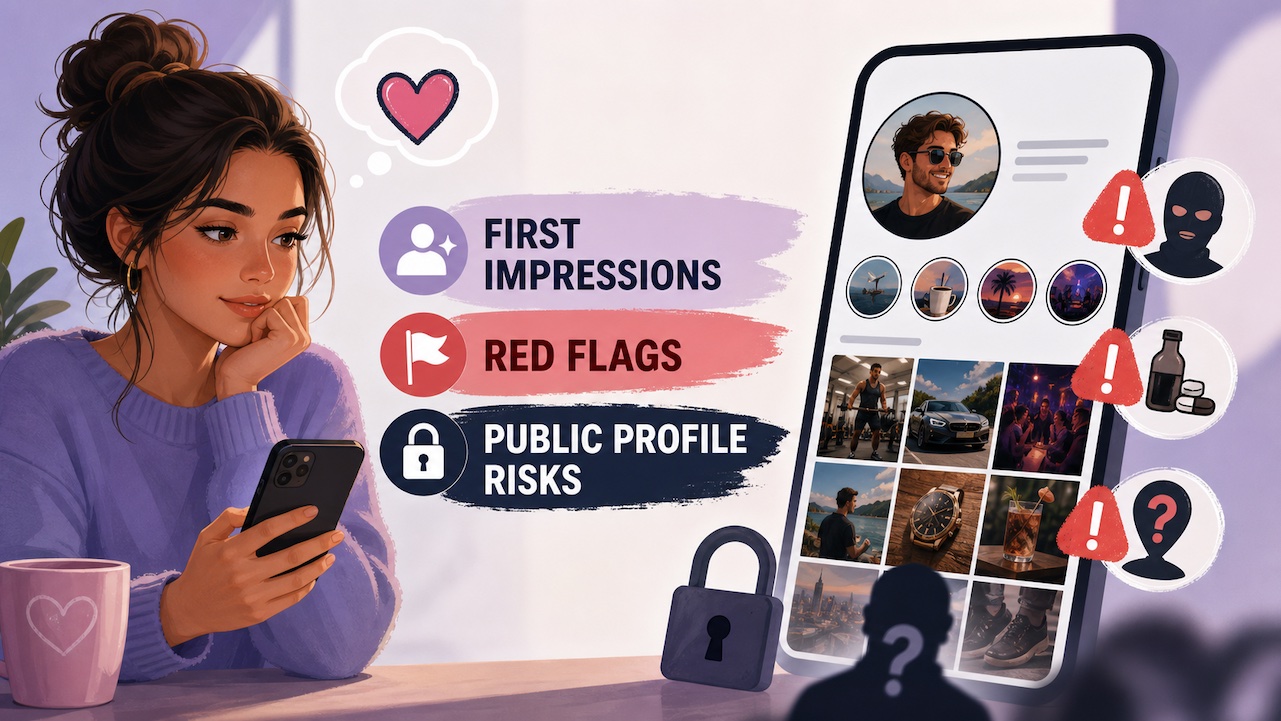
Why People Check Instagram Before (or Instead of) the Dating App
There are around 80 million single Americans using dating apps/websites. And a recent statistical analysis found that 44% of users check the social media of their match before meeting. And back in February 2025, Rizz (an AI dating coach app) shared some data with Business Insider that the biggest chunk of message screenshots they get for advice/suggestions comes from Instagram. Tinder and Hinge together accounted for 21% of messages, whereas Instagram was 22%.
Of course, there's no large-scale study guaranteeing these numbers. But you see the trend here. Instagram is super important. And most people check it before they make more serious dating decisions—including the first meet. It would be safe to say that checking a potential match's Instagram isn't a fringe habit but standard practice today.
A dating profile is written to be dated. An Instagram profile is just … a life. It surfaces things a dating bio can't: tagged friends, years of consistent posting, unposed moments, humor that isn't optimized for swipes, and so on.
Of course, Instagram is curated too. But it's curated for friends and followers, not suitors or romantic partners. It's a second data point for most people, not the “unfiltered truth” as some might believe. Even on Instagram, we engineer a bit. But the engineering is more generalized and less filtered vs. a dating profile, as the job of every person's every post isn't to bag a new suitor or find a match.
Bottom Line: A well-kept, personality-forward Instagram profile absolutely outshines a generic dating bio. An inconsistent, dead, or awkward profile can also undo a great dating app impression. Cuts both ways!
Should You Make Your Instagram Public for Dating?
Should You Make Your Instagram Public for Dating?
An empty or locked-down profile can itself read as a red flag to someone doing their own check. Public profiles aren't just for being found but for looking verifiable and normal to a complete stranger who's being cautious. And one can never be too cautious with the current catfishing rates. A ton of people are worried about being catfished or wasting time. An authentic, public Instagram feed with many real moments allows such a cautious stranger to trust you more.
But isn't a public profile a risk? Well, kind of. Think of balancing your profile. Public doesn't need to mean “here's everything about me.” A better way to think of what your public Instagram profile needs to be is having a curated profile. That means a tidy grid, no sensitive tags, no location data. This is better than a fully locked account or an unfiltered public diary, both.
Public vs. private profiles are not an all-or-nothing decision. Careful curation can help you avoid giving unnecessary or private information even over a public profile. Also, many keep a public “front door” account (photos, interests, personality) while keeping close-friends-only Stories or a separate personal account for the unfiltered stuff.
Before we move on, two small caveats:
- As of May 2026, Instagram DMs lost end-to-end encryption.
- Going public strictly for dating purposes means your existing followers, such as coworkers, family, old friends, etc., can all see a stranger commenting and liking your stuff.
The Privacy and Safety Risks of Going Public
There are certain very real risks that you must balance. We can't tell you that if you do this, not do that, etc., then you're safe. Not how it works. You have to calibrate your online presence based on your rules. What we can do is tell you exactly what parameters to fine-tune:
- Geotags, the newer Friend Map/location-sharing feature, and even weather stickers on Stories can be pieced together into a routine (home, gym, regular coffee shop) without you ever “meaning” to share it. Avoid.
- Tags from other people are a blind spot. A friend tagging you at a bar or in front of your building leaks location and routine data, even if you personally never post it and it still shows up under your profile's tagged section. If this happens, tell your friends not to do that without confirming. You can also remove such a tag by going to Tag Options or hide the post from your profile grid.
- Once someone's seen your full public presence, a rejected match or a person you ghost after one date now has a route to find your workplace, gym, and daily pattern—this is the direct line from “harmless profile check” to harassment, and Pew's own data shows a meaningful share of daters report unwanted contact after saying no (Pew found that 43% of younger women have had someone continue to contact them after they said they were not interested. 37% have been called an offensive name).
- Your own public photos can be lifted and reused by someone else to catfish other people under your face.
- Strip location tags from posts, manually approve tags before they appear, turn off the location/friend map, keep the bio free of employer/city/school specifics.
Red Flags to Spot on an Instagram Profile Before You Meet Someone
Finally, we come to the meat of the discussion. You're ready for that second data point after the dating profile/conversation. What's clearly a red flag?
- Scroll to the earliest posts. A genuine account usually has months or years of gradual history. An account that's only a few weeks old, or has a big burst of photos all uploaded at once to look established, is the classic tell.
- Following thousands while barely being followed back, or a suspiciously high follower count paired with near-zero likes/comments, both of these patterns show up disproportionately on fake accounts.
- Real people post a messy mix of photos. That means bad lighting, awkward angles, and unflattering candids. Wall-to-wall studio-quality, zero-candid photo grids are a legitimate flag.
- Reverse image search has become less powerful. Before AI tools like Midjourney and Sora-based generators, you could do a reverse search and find if a match exists. But today, even if it returns “no results,” it doesn't automatically mean the person is real, because it could be a photorealistic AI image.
- Check for social proof. Do real people—recognizable, repeat commenters and tagged friends—actually appear across the account? A profile that never shows up in anyone else's posts, or has only generic/bot-like comments, is worth a second look.
- If their dating app bio says one job/city/age and Instagram tells a different story, that's a direct, checkable inconsistency worth a casual (not accusatory) question.
- Refusing basic verification is the strongest single signal across virtually every current source on this: won't do a quick video call, always has an excuse (bad wifi, shy, camera's broken). Patterns aren't coincidental if you suspect something fishy.
- Intense compliments or declarations of feelings within days, or a push to move the conversation off-platform (WhatsApp, Telegram) before you've even met in person—both are textbook, well-documented manipulation patterns.
Related Articles
This article will discuss methods for viewing Instagram stories when you have been banned by Instagram.
Learn how Instagram comparison, curated images, and body-shaming can affect self-image, and how to adjust your feed without treating a break as a cure.

Instagram's ranked Home feed, off-site tracking, ads, and recommendation systems explain why followed accounts disappear and why creator reach is so unpredictable.